
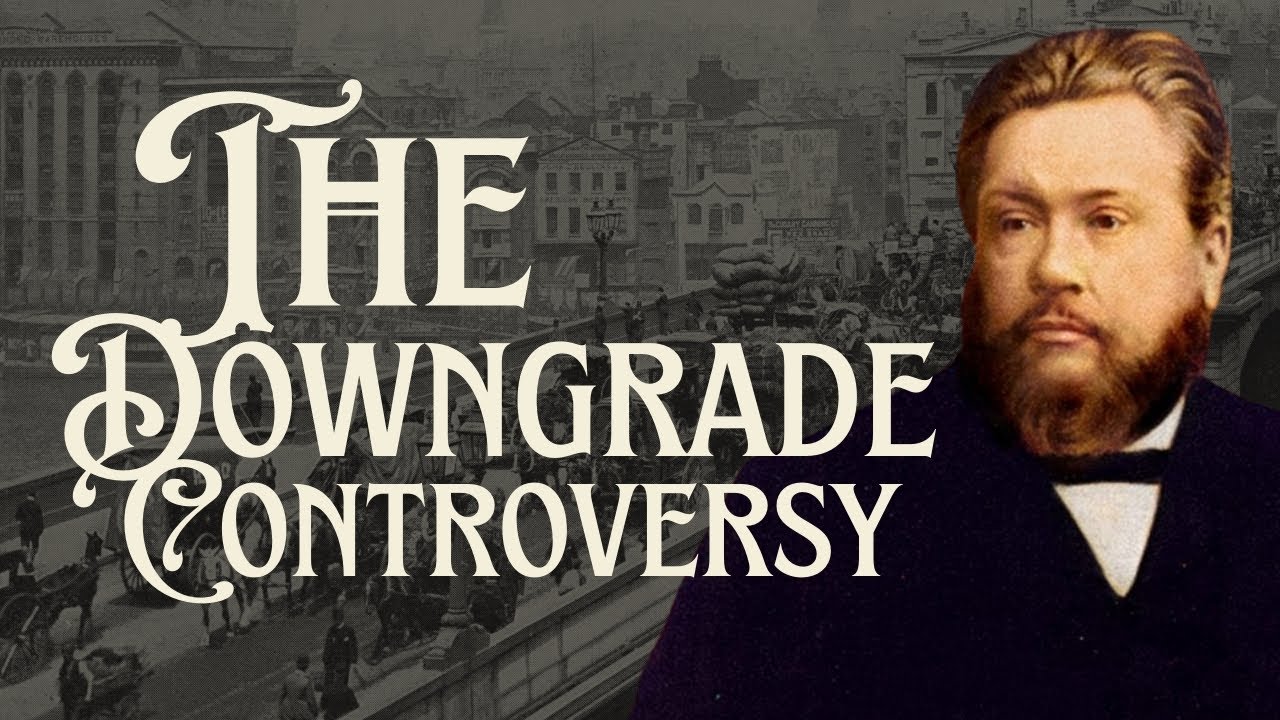
The “Downgrade Controversy.” Few Christians know what that is. Roughly 150 years ago, in England, the Baptist Union was having some internal issues over doctrinal stands. The vast majority of the preachers in the BU were orthodox, but they had begun to relax their standards and convictions concerning what I would call the Fundamentals of the Faith. Certain men lobbied for a softer stance concerning doctrine, seeking to fellowship with a new batch of ministers who had been influenced by Charles Darwin (Evolution) and sought to merge “science” with the Bible. This same group of clergy men had also been swayed by German Rationalism. This rationalism would also be called “Higher Criticism”, which was a constant, vicious attack on the Word of God. These beliefs would be the beginnings of what would become known as the Modernist’s Movement. To use a description from Jude, men and godless philosophy were “men crept in unawares.” The Baptist Union mantra would be — we don’t wish to divide, but to be governed by love and acceptance.
Four main areas of contention would be identified by the great Spurgeon in his paper “The Sword and the Trowel.” The messages were called “The Downgrade.” Spurgeon rightly knew that if you denied certain foundational doctrines, you no longer had Christianity. The first three contentions would be denials by the modernists of the inspiration, inerrancy, and infallibility of the Bible, they denied the necessity of the substitutionary death of Christ and, they denied the existence and eternality of Hell. The fourth belief wasn’t a denial; it was about their heretical belief in Universalism.
Universalism is the teaching that everyone will be saved and no one would ever be punished in a place such as Hell. The emphasis is always on the love of God and the compassion of God. Spurgeon took a stand against the compromise on these key points. “The case is mournful. Certain ministers are making infidels. Avowed atheists are not a tenth as dangerous as those preachers who scatter doubt and stab at faith… Germany was made unbelieving by her preachers, and England is following in her tracks.” Spurgeon resigned from being a part of the BU. He lost the friendships of many fellow pastors who claimed he was causing division. Over 80 of the young preachers in the Bible College turned against him. The Baptist Union, although he’d already separated, voted to censure him. To censure was to publicly, with all your influence, position and power, disapprove of someone and in ministerial circles meant never to fellowship. Even some in his church began criticizing him for his unwavering beliefs in Orthodox foundations of Christianity. He knew that doctrinal compromise always meant dire consequences in the not-so-distant future. His own brother, James, thought he was wrong and seconded the vote to censure him. His brother was hoping Charles would see he needed to change.
I believe history has vindicated Spurgeon. He is called “the prince of preachers.” God continues to use his writings and sermons even though he died in 1892. All of those ministers that voted to side with the modernists are men with little influence. We know very little about them, but we sure do know a lot about Spurgeon. His stand for orthodox Christianity and the criticism he endured, along with an already infirmed body, led to an early death, at least that’s my opinion. For years he battled with gout and later Bright’s, which is a kidney disease. He died at 57 years-old.
As I was thinking about Spurgeon, my mind kept going to Psalm 55. Written by David, most likely when Absalom was seeking his life, trying to usurp the throne. The man that David most highly sought, especially when extra-ordinary counsel was needed, was a man named Ahithophel. He was considered to be the very oracle of God. But something happened to Ahithophel that he could not get over. David had committed adultery with his granddaughter, Bathsheba. David had caused a great embarrassment to his esteemed family. Because of being wounded by David, Ahithophel turned his back on his king, giving his counsel and support to Absalom, David’s own son and now enemy. It shook David to his core. The psalm title calls it a “Maschal.” The word simply means “a teaching or an instruction.” What is David sharing in this psalm? He’s reflecting on his circumstances and the people who once were near and dear, yet now things have changed and it isn’t for the better. No doubt he’s looking inward and asking questions about himself.
1. He begins with begging prayer and many doubts personally. 55:1-5. When times are pressing, it drives us to our knees as we cry out to God. David certainly understood this. He’d done this on numerous occasions earlier in his life as Saul was chasing him in multiple efforts to have him killed. But the episodes by Saul were well behind him. He had come through those desperate times with a strong faith. This is different. Those who had been with him for many decades have now become his enemy. How many times do you think he asked himself, “What should I have done differently with my son Absalom?” How many times do you think he wished greatly that he would have gone to the battle with the kings instead of walking around on his terrace and laying eyes on Bathsheba? It is a wise soul that looks inward first and foremost. As much as he felt emotionally, he still had the where withal to go to the Lord. The great emotion he faced, at least in his own mind, was that God had abandoned him. God hadn’t, but it seemed that way to David. We see that in vs. 1. When looking at v.3, you’ll notice the word “oppression” and it means an outcry. The phrase he used is “the oppression (outcry) of the wicked.” The picture is one of a deer being chased and the hounds can be heard in the distance and they are closing fast.
2. He then begins to fantasize about having wings. 55:6-8. Who among us have not had thoughts like he did when our cross gets heavy? Why do we take vacations? We sometimes just need a time to reflect, relax and rejuvenate. But David was in no position for a week on the Mediterranean coast line; he was being stalked again for the second time in his life. The closest he came to flying away was slipping out of Jerusalem under the cover of night because he didn’t want to have the people of Jerusalem get caught in a battle between his soldiers and Absalom’s. He had already seen people suffer inside the city (v.9), and he longed for peace at any price.
3. He then shares why the pain was so great. 55:12-21. It wasn’t the dreaded Philistines that had risen up against him it was his own son and a man (Ahithophel) who was “his equal” and with whom he had “walked unto the house of God in company” (v.13,14).
My space is gone for today but read Psalm 55. See the pain that David described. Think about what he was asking God to do for him. Think about Spurgeon and the pain he endured the last five to six years of his life. Think about regular Christians that have had family turn on them because they became believers. Many different events can drive a believer emotionally. It may be the fall of a minister or a call from a doctor. A truth to live by, in the form of some questions, I ask you to remember when you think about the heartaches that have come your way and you, like David, are wanting to fly away. Have you been beaten with a whip? Have you been pummeled with fists? Have you been spat on? Have you been nailed to a cross? None of us have at this time. Remember Jesus said, “The servant isn’t greater than the master.” If Christ was hated and rejected, why should we think our Christian faith won’t be also? Stay strong.